
Best Air Hockey Electronic Scoring Units for Quick, Accurate Scorekeeping
Disclosure: As an Amazon Associate I earn from qualifying purchases.
Choosing an electronic scorer for air hockey starts with a simple distinction: do you need to repair the scoring system on a table you already own, add a separate score display, or buy a complete table that includes electronic scoring? Those purchases are not interchangeable. A full game table is not a universal replacement module, and a power adapter cannot detect or display goals by itself.
The product links below are complete air hockey tables with electronic scoring. They are alternatives for a new-table purchase, not retrofit recommendations for an existing table. For replacement-unit buyers, the first sections explain how to identify the compatible part and avoid ordering the wrong category. This guide does not claim hands-on accuracy tests, universal compatibility, or measured reliability rankings.
Decide which scoring problem you are solving
An existing table whose automatic scorer has stopped working
Record the table’s exact brand, model, and identifying label before shopping. The scorer can consist of a display, controller, goal sensors, connecting cables, and a power source. A failure in one part does not establish that the entire display needs replacement. Describe the symptom clearly when contacting the manufacturer: completely dark, one side not registering, repeated points, or resets during play.
Consult the table’s parts diagram and service instructions rather than relying on the appearance of a scoreboard. Similar housings can have different connectors, operating voltage, sensor arrangements, or control behavior. A part sold for a related table or brand is not automatically compatible with every model in that family. Obtain an exact part-number and revision match from an appropriate supplier before ordering.
Ask what the replacement includes. A display-only item may require the existing sensors and cable harness, while a complete assembly may include different components. The power adapter can be a separate part. Do not buy one merely because its plug fits: voltage, current requirement, polarity, connector, and manufacturer approval all matter. Replacing a damaged supply with an unsuitable one can create a new problem rather than repair the original fault.
A table that has never had automatic goal detection
Adding a display is a different project from adding sensors that recognize a puck entering a goal. An automatic retrofit needs a compatible detection arrangement, controller, power supply, mounting method, and suitable goal geometry. A broad “electronic scoreboard” description may refer only to a manually operated display. Confirm the intended operation before changing the table or cutting any mounting holes.
Ask the table manufacturer whether a supported retrofit exists for the exact model. If it does not, do not assume a scorer from a complete table can be transplanted successfully. A bespoke conversion may require specialist design and can affect serviceability. Compare that project with retaining manual scoring rather than treating every unmodified table as one inexpensive module away from automatic operation.
A separate manual electronic score display
A manually updated electronic board can be a reasonable way to make the score visible, but someone still has to award each point. It does not establish automatic goal detection or prevent scorekeeping mistakes. Decide whether players can reach its controls conveniently or whether another person will operate it. Keep the display and controls out of the puck’s path and normal player movement.
Read the package description carefully to establish whether a separate board is manually operated or supplied with a compatible goal-detection system. If visible numbers are all you need, it may be a different purchasing task from repairing a built-in automatic scorer. Do not pay for an automatic-scoring promise when the actual package is a button-operated display without sensors.
What matters in a replacement assembly
Compatibility is more than brand and table length
Use the exact table model and the manufacturer’s current replacement information. “Fits a 54-inch table” does not establish the goal dimensions, sensor positions, or electrical interface. Even tables with the same nominal length can be unrelated designs. Photographs help identify a part, but the confirmed part number and supported table list should control the purchase.
A supplier should explain whether a newer part supersedes an older number and whether any additional components are needed. Keep that confirmation with the order record. If a replacement is described as covering both dome hockey and air hockey, verify the actual supported models and configuration. The fact that two games use electronic scores does not make every scorer interchangeable between them.
Ask whether the item is an original approved replacement, a compatible aftermarket assembly, or a salvaged part. Those descriptions imply different support and return considerations. A used display may be a practical repair choice when its identity and condition are established, but it should not be presented as a new universally supported unit. Confirm the installation and service route before consuming the return window.
Check how points and corrections work
Goal detection, score display, reset controls, and sound effects are separate functions. A bright LED number does not reveal whether a goal is detected automatically. Ask how the system handles a puck that enters then rebounds, a puck resting partly in the opening, and repeated movement through the goal area. Follow the specific table’s instructions when deciding whether a point should count.
Some systems allow manual correction, while others may require a reset or a different documented procedure. Confirm the actual behavior rather than assuming there are dedicated correction buttons. Choose a system whose controls support the way you play, including the intended winning score or timed mode if documented. A score limit that suits casual family matches may be inconvenient for a different competition format.
If scoring errors are frequent, address their cause instead of adding a display that makes the errors more visible. Describe whether the issue occurs on one side, with particular pucks, or after a change in position. A compatible service provider can use that information to distinguish mechanical, sensor, connection, and power problems. Do not claim a specific diagnosis from the symptom alone.
Complete-table options with electronic scoring
These selections are relevant only when you are buying a complete table. They do not supply a verified standalone retrofit kit for a different table. Compare their whole-room and ownership requirements alongside the built-in scorer rather than ordering a large game table to solve a small replacement-part problem.
MD Sports five-foot arcade table: a documented compact complete system

The linked MD Sports option is the five-foot arcade style, model AH060Y24006, with assembled dimensions of 60 by 32 by 32 inches. The manufacturer’s model page identifies the complete air-powered table and its integrated scorer. It is a possible new-table choice when that footprint and the required surrounding room fit your home.
Its electronic scoring and blower use different power arrangements. The official AH060Y24006 manual specifies two AAA batteries for the scorer, not included. Do not assume the blower’s plug-in supply also powers the scoreboard. Confirm current supplied accessories and assembly requirements for the actual offer.
Choose it for a complete smaller home table with documented model information, rather than for a replacement scoring unit. A compact footprint can be useful, but it does not establish tournament play, comfortable player clearance, or the ideal height for every child. Its scorer should be checked during initial setup together with table leveling and normal puck movement.
Hyner 54-inch table: verify the complete configuration before purchase

The linked Hyner ASIN identifies a 54-inch complete air hockey table advertised with LED electronic scoring and goal lights. The identified package includes two pucks and two pushers. It belongs here as a whole-table alternative for a home game space, not as a loose scoreboard or a confirmed electronic retrofit assembly.
Before ordering, obtain the actual assembled dimensions, manual, scoring operation, and power requirements for the delivered model. Some retail dimension fields are inconsistent, so this guide does not use them as a verified room-planning measurement. The nominal 54-inch title is insufficient for delivery access, table height, or the space players need around it.
Consider it when the confirmed footprint and current package support your intended casual play. Bright scoring or goal-light claims do not establish independently measured detection accuracy, durability, or professional arcade performance. Ask how automatic registration, reset, and any corrections work, and whether replacement scoring components can be obtained. Those answers matter more than generalized claims of a powerful motor or robust construction.
EastPoint NHL Power Play 80-inch: electronic scoring within a larger combo table
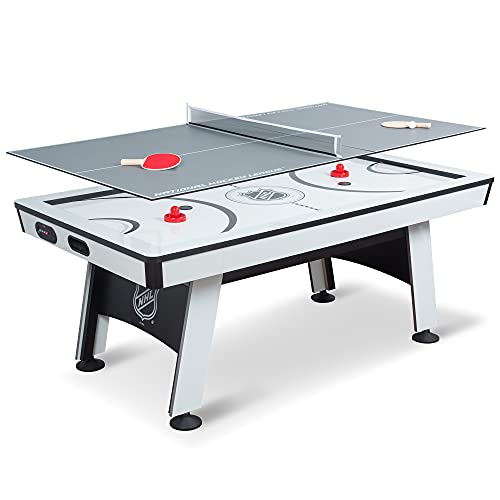
This link identifies the EastPoint NHL Power Play model 1-1-34777-DS, an 80-inch air hockey table with a table-tennis conversion top. Its brand listing includes LED scoring, stadium sounds, light-up corners, and the game accessories. The manufacturer-authored assembly manual identifies the corresponding 1-1-34777 model family.
This is a new-table option for a buyer who wants both games and can accommodate the larger installation. Include storage and safe handling of the conversion top, delivery access, electrical requirements, and assembly help in the purchase plan. The scorer is part of that table system; the link is not a verified replacement scoreboard for a different air hockey table.
Choose it for the whole game arrangement when the actual room supports it, not because a larger table supposedly creates more players or automatically improves scoring accuracy. Review the delivered manual’s age and assembly instructions. Confirm that the current offer includes the conversion top and accessories rather than assuming every listing under the family name has the same contents.
Giantex 54-inch: electronic display with a manual scoring fallback

The linked Giantex is the 54-inch table with LED electronic scoring, goal lights, and built-in sliding scorers. The manufacturer’s product page lists overall dimensions of 54 by 25.5 by 34 inches, two pucks, two pushers, and an adapter. Its manual sliders provide a separate way to keep score.
That combination can suit casual household play when you want an electronic display without depending on it for every match. Confirm how the electronic system registers goals, what powers each component, and how resets work. A sliding scorer is a useful fallback category, but it does not prove that an electronic point can be corrected through the same control.
Shortlist it as a complete smaller table after checking room clearance and the supplied manual. Do not assume its lights, display, or sensor components fit another manufacturer’s table. The listed 12V blower characteristic is not a direct airflow comparison with other products, and its appearance should not be presented as evidence of independently tested arcade-level performance.
Make the room usable for the players
Measure more than the tabletop length. Players need access at both ends, room for movement, and a clear route around the table. Nearby shelving, furniture, and stored accessories can interfere with normal play even when the cabinet fits between them. Mark the intended footprint on the floor and consider actual users before deciding that a compact or full-size table is suitable.
Check whether both players can read the display from normal positions and whether overhead lighting produces glare. The display can be large and still be poorly positioned for a particular room. Put spectator access and score controls where they do not create interruptions or collisions. Avoid placing a separate screen where a puck or pusher can strike it during ordinary play.
Level the table as its manufacturer directs before evaluating the scoring experience. A puck that repeatedly drifts or catches near a goal can affect play independently of the display. Inspect the supplied pucks and use the compatible size and type. A different puck sold for another table may behave differently and should not be assumed suitable merely because it slides on the surface.
Plan a safe cable route and accessible power arrangement, using the supplied or manufacturer-approved equipment. Keep cables from becoming a trip hazard and do not improvise an electrical connection to relocate a scorer. Follow the table’s indoor-use and care instructions. A home game setup should remain easy to inspect and service rather than hiding every connection behind permanent furniture.
Check the scorer during first setup
Test the documented controls with the table properly assembled and positioned. Confirm that both sides display the expected starting score and that each goal registers as instructed. Use the supplied puck and ordinary play conditions. This acceptance check is useful for detecting an installation or supplied-component problem; it is not a controlled accuracy test or a guarantee against later faults.
Review reset behavior, sounds, score limits, and any documented correction method. If the scoreboard behaves inconsistently, record what happened and contact support while the purchase details are readily available. Do not open an electrical assembly or modify a sensor circuit to force a result. Retain the manual, packaging, and part numbers until the delivered system has been checked.
Agree on a simple household rule for disputed goals before a match. The MD Sports manual, for example, distinguishes a puck entering and dropping into the goal from one that rebounds out. Apply the actual game’s instructions rather than letting any sound or light automatically settle every dispute. If the scorer cannot be corrected easily, decide how players will handle that situation without repeatedly interrupting the game.
Compare replacement cost with the actual table condition
Before committing to a scoring repair, assess the rest of the table. A compatible replacement display may be worthwhile when the cabinet, playfield, blower, goals, and legs are in usable condition. It may be poor value when the scorer is only one of several unresolved problems. Obtain the complete repair estimate rather than comparing the price of a single module with the price of a fully working new table.
Include any diagnosis, approved adapter, sensors, delivery charges, and installation work required for the repair. Conversely, include delivery, assembly, disposal of the old table, and room changes when comparing a complete replacement. These are different projects with different costs. A larger new table is not automatically the sensible answer to a failed small display, while an inexpensive display is not a bargain if it cannot be supported on your model. Keep the purchase tied to the result you need: usable play with understandable, reliable scorekeeping and an available service route.
Preserve a sensible service route
Keep a short record that a supplier can use to identify the correct component:
- The table’s exact model number and any relevant serial or revision label.
- The scorer’s part number and the information printed on its power supply.
- Which functions work and which fail during ordinary play.
- Whether the manual describes separate sensors, a display assembly, or an integrated system.
- Photos of the existing labels and connectors taken without dismantling powered equipment.
Keep the table model, scorer part identification, adapter label, and purchase record together. A fault months later is easier to resolve when you can identify the system without guessing from the cabinet’s decoration. Ask about replacement sensors, displays, harnesses, and approved supplies before buying a complete table, especially when electronic scoring is the feature you most value.
Follow battery and storage instructions for the exact scorer. Battery-powered displays require their own attention even while a blower still works from its adapter. Remove or replace batteries as the manual directs, and have leakage or damaged contacts addressed appropriately. Do not treat an operating blower as proof that every electrical component is receiving suitable power.
The right purchase depends on the original problem. For an existing table, obtain a confirmed compatible scoring part or repair assessment. For visible manual scorekeeping, recognize that a separate board still requires someone to award points. For a new table, the four complete systems provide different sizes and features to investigate. Keeping those categories clear is the best way to avoid buying a power supply, an unrelated module, or an entire table when you intended something else.