
In this guide
When planning backcountry ski trips, choosing the right poles can influence stability, balance, and efficiency on steep bootpacks and varied terrain. This guide highlights five top picks designed for backcountry use, with a focus on adjustability, grip comfort, packability, and durability. Each product has features tailored to touring, splitboarding, and extended ascents, helping you maintain confidence from ascent to descent.
Summary of chosen products:
| Product | Brand | Adjustability | Notable Feature |
|---|---|---|---|
| LEKI Helicon Lite Aluminum Adjustable | LEKI | 110-145 cm | Speed Lock Plus, extended foam grip |
| LEKI Sherpa Lite Aluminum Adjustable | LEKI | 100-135 cm | Speed Lock 2 Plus, lightweight slim design |
| LEKI Haute Route 2 Aluminum Adjustable | LEKI | 110-150 cm | Two-piece touring pole, Aergon Extended Grip |
| MSR DynaLock Ascent Foldable Carbon | MSR | ~ adjustable; 20 cm range | Kevlar-reinforced carbon, three-piece folding |
| G3 VIA Aluminum Ski Poles | G3 GENUINE GUIDE GEAR | Two-piece adjustable | Ergo dual-density grips, QuickFlick Utility |
LEKI Helicon Lite Aluminum Adjustable Poles

The LEKI Helicon Lite is built for backcountry touring with a focus on lightness and convenience. Its 110-145 cm adjustability uses LEKI’s Speed Lock Plus to secure length changes quickly, making it easy to adapt to varying terrain. The extended foam grip reaches down the pole for reliable handling on steep switchbacks, and its overall construction prioritizes stability without adding unnecessary weight. This pole suits skiers who want a robust, adjustable option without sacrificing packability during long ascents.
LEKI Sherpa Lite Aluminum Adjustable Poles

The Sherpa Lite pairs a lighter, slimmer profile with strong adjustability, designed for backcountry skiing and hiking alike. Speed Lock 2 Plus offers extended length range (100-135 cm) to accommodate different heights and snow conditions. The Aergon Air Extended Grip uses thermo foam with a rubber backing, delivering superb grip and a foam extension for choked-down handling on steep bootpacks. This pole is ideal for skiers who prioritize reduced weight without compromising comfort on longer ascents.
LEKI Haute Route 2 Aluminum Adjustable Poles
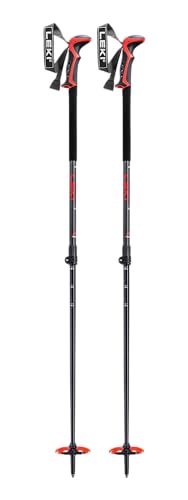
The Haute Route 2 delivers a versatile two-piece touring design with a broad 110-150 cm adjustability range, ready for aggressive backcountry days. Its Aergon Extended Grip emphasizes lightweight ergonomics, with a foam extension for comfortable choke-down control during steep bootpacks. This model targets skiers who need an adjustable pole capable of long ascents and dynamic descents across variable snow and terrain.
LEKI Sherpa FX Carbon Max

Note: This Leaner, carbon-focused model emphasizes collapsibility for backcountry touring and splitboarding. It collapses into three pieces for compact packing while maintaining 120-140 cm adjustability and a secure Speed Lock 1 Plus system. The design prioritizes packability and ease of transport alongside solid grip for challenging ascents and line choices.
MSR DynaLock Ascent Foldable Carbon Poles

MSR’s DynaLock Ascent uses a carbon fiber core reinforced with Kevlar for ultralight strength. Its three-piece design folds compactly for easy packing, making it ideal for splitboarding and summer hikes in the backcountry. The DynaLock mechanism permits tool-free tension adjustments across a 20 cm length range, offering quick customization during climbs and traverses on varied terrain.
G3 VIA Aluminum Ski Poles

G3 VIA poles combine durability with practical versatility. The two-piece design features ergonomic dual-density grips and QuickFlick Utility Tabs that simplify heel lifts, buckles, and glove handling. A removable backcountry strap adds comfort and safety in avalanche terrain, while the 85 mm all-mountain basket handles diverse snow conditions. These poles aim at backcountry enthusiasts who value rugged construction and functional access points during ascent and descent.
Buying Guide: Key Purchase Considerations
- Adjustability range: Backcountry poles should offer a wide length range to accommodate varied terrain, rider height, and snowpack depth. Look for locking mechanisms that are reliable and quick to use, such as Speed Lock or similar systems.
- Weight vs. durability: Carbon fiber poles are lighter and stiffer but may cost more and be less forgiving in rocky terrain. Aluminum poles tend to be more affordable and durable for grueling tours, though heavier.
- Grip and shaft design: Ergonomic grips that extend along the shaft aid in switchbacks and steep bootpacks. Foam grips with a rubber backing often provide solid purchase in cold or wet conditions.
- Packability: If you frequently travel with your gear, collapsible or foldable designs can save space in packs or vehicles. Three-piece collapsible poles maximize portability.
- Backcountry features: Look for added safety and convenience elements—removable straps, quick-release tips, and compatibility with trekking or splitboard setups if you venture beyond groomed trails.
- Terrain considerations: For varied backcountry terrain, poles with dependable locking mechanisms and secure grips reduce fatigue during long ascents and aid in precise pole plants on uneven snow.
- Compatibility with accessories: Some poles include attachments for gloves, heel lifts, or compasses, which can be beneficial in avalanche terrain or when routing through deep snow.
In selecting backcountry ski poles, balance weight, strength, and ease of use. The five options featured here provide a spectrum—from ultralight carbon to rugged aluminum—each with design choices aimed at improving grip, stability, and efficiency during ascents and descents across backcountry conditions. Analysts and climbers recommend testing pole stiffness, grip reach, and locking reliability in a controlled environment before venturing into more demanding terrain. Consumers should align their choice with typical ascent lengths, snow conditions, and personal comfort with grip depth and pole length adjustments.