
Best Water Bottle With Mouthpiece for Easy Hydration on the Go
Affiliate disclosure: As an Amazon Associate I earn from qualifying purchases. Purchases through our Amazon links may earn us a commission.
The best water bottle with a mouthpiece is one you can drink from comfortably, carry in the places you need and clean without a complicated routine. A straw, a covered drinking spout and a dual-opening lid solve different problems. Choosing the lid style first makes the capacity and material comparison much more useful.
The five selections below span smaller refill-friendly bottles and larger insulated designs. Product identity and stated features inform the comparison; no leak, temperature-retention or drop test is presented as our own result. Focus on the selected size and lid, because changing a color or capacity on a product page can also change the item you actually order.
Choose How You Want to Drink
A straw-style opening is useful if you prefer sipping while the bottle stays relatively upright. A direct drinking spout usually involves tilting the bottle. A lid that supports both can be convenient when you use the same bottle at a desk and during breaks, but it also introduces more parts to understand and clean.
Look at where your mouth contacts the lid and how that surface is covered during carrying. A push-button cover may be convenient, while a lock can help prevent an unintended opening. Neither feature guarantees that a bottle will remain hygienic or spill-free without correct assembly and care.
Consider the actual grip. A large insulated bottle may be comfortable to carry by a handle but awkward to lift with one hand while seated. A smaller plastic bottle may be easier to hold, yet need more refills. The lid should fit the task rather than requiring you to change an ordinary drinking routine to justify the purchase.
Distinguish a wide filling opening from the drinking mouthpiece. A bottle can have a large opening when the lid is removed and a narrow straw while drinking. The first affects filling and cleaning access; the second affects the way you sip. The phrase wide mouth does not settle both questions.
Five Mouthpiece Bottles to Compare
POWCAN 40 oz, Cotton Candy: Larger Capacity and Two Drinking Openings

The linked POWCAN is the 40 oz Cotton Candy selection with a straw-and-spout lid. Its stainless-steel insulated construction and dual drinking arrangement make it a candidate for a day when you want fewer refills and different ways to drink from the same bottle.
Why consider it: the capacity and two-in-one lid fit your carrying space and you actually use both openings. The current listing advertises up to 24 hours cold; treat that as a stated retention claim rather than a guaranteed temperature in your bag. Before ordering: check the exact lid components, the cleaning guidance and the bottle dimensions. A 40 oz capacity describes the contents, not whether it fits your cupholder or bag pocket. Do not infer that every beverage is permitted because the body is insulated steel, and do not assume the straw arrangement is suitable for hot liquids without explicit instructions for this selection.
NAVTUE 16.9 oz, Deep Black: A Smaller Bottle With Time Markers
The selected NAVTUE is identified by exact-item retail information as a 16.9 oz, 500 ml Deep Black Tritan bottle with time markers and a quick-flip lid. Its smaller format is worth investigating if you can refill regularly and prefer carrying less water at a time.
Buyer fit: desk use, a shorter trip or another routine where convenient refills are available. Check before buying: the mouthpiece shape, the lock’s operation, the carry-strap arrangement and the actual cleaning instructions. The listing’s BPA-free wording is a material claim, not a medical or child-use certification. Time marks can prompt you to remember the bottle, but they do not establish an individualized drinking requirement. Leakproof marketing also should not be extended to an incorrectly closed or damaged lid. Make sure the 500 ml capacity suits the time between your real refill opportunities rather than following a motivational schedule printed on the bottle.
Owala FreeSip 24 oz, Denim: Sip Upright or Tilt to Drink
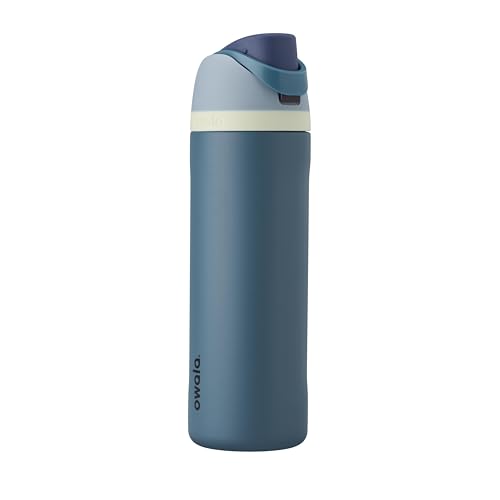
This link selects the 24 oz stainless-steel FreeSip in Denim. Its FreeSip opening lets you use the built-in straw while upright or tilt the bottle to drink through the wider opening. Owala’s model information identifies a covered push-button lid and a carry loop that also acts as a lock.
Why it belongs here: one drinking surface provides two styles without changing lids. What to verify: the selected 24 oz dimensions, the way the cover opens and the cleaning routine for the lid, straw and body. Owala’s usage guide excludes hot, carbonated and perishable liquids for the stainless-steel FreeSip. Do not turn a general insulation claim into permission to use it as a hot-drink or food-storage bottle. The model is marketed with a leakproof lid, but correct seals, assembly and closure remain part of normal use rather than a guarantee that no spill can occur.
OLDLEY 32 oz, Clear: Visible Contents and a Refill Reminder

The linked OLDLEY is the Clear 32 oz single-bottle Tritan selection with time markers and a button-opening lid. Visible contents can help you notice when a refill is needed, while the size provides a different carrying tradeoff from the smaller NAVTUE option.
Reason to compare it: you want to see the contents and prefer a marked bottle for an ordinary desk, gym or travel routine. Before ordering: establish the actual lid cleaning method, the mouthpiece style and whether the dimensions suit your hand and carrying pocket. BPA-free and Tritan wording do not establish that it is safe for every temperature, beverage or dishwasher cycle. The markers are reminders rather than a medical schedule, and a clear body does not remove the need to clean the lid’s less visible parts. Confirm the applicable instructions instead of borrowing them from another plastic bottle with a similar appearance.
Owala FreeSip Sway 30 oz, Dreamy Field: Handle and Dual-Style Drinking

The selected Sway is the 30 oz Dreamy Field stainless-steel version. It uses the FreeSip drinking concept with a larger carry-handle arrangement and a covered lid. Owala’s Sway information is useful for comparing the exact size and its dimensions rather than treating every Sway capacity as the same physical bottle.
Who may prefer it: someone who carries a bottle between activities and values the handle while still wanting upright sipping and direct drinking. Limits: a handle does not establish compatibility with your pocket, cupholder or hand size, and a larger capacity adds weight when filled. Obtain the Sway’s own care guide and beverage restrictions instead of assuming every Owala lid is interchangeable. Confirm the supplied straw and seals for this size if replacement parts are important to your plan. Choose it for the actual carrying and drinking routine, not an unsupported claim that its lid is more durable than another design.
Pick Capacity From Refill Opportunities
Describe the period between places where you can refill safely and conveniently. A bottle for a desk with nearby water access can be smaller than one you carry through a longer outing. Capacity is a planning decision, not a measure of how seriously you take hydration.
The tradeoff is the amount you carry against the number of refills you accept. A larger bottle may reduce stops, but it occupies more space and weighs more when filled. A smaller one is easier to fit into some routines, but is less useful if it empties long before the next available refill.
Consider whether the bottle will sit on a surface or stay with you throughout the day. A 40 oz bottle at a desk creates different handling needs from the same bottle carried in a shoulder bag. Do not assess convenience only while the bottle is empty in a product photograph.
Use time markers as optional reminders. They do not identify the amount any particular person must drink, and resetting or refilling a bottle can make a printed timeline irrelevant. Choose a routine that matches your actual circumstances instead of treating the marks as a prescription.
Measure the Places Where the Bottle Must Fit
Check diameter, height and the space occupied by the handle or cover. Bottle capacity alone does not establish cupholder fit. A tapered base may help with one holder while a different holder is narrower or shallower. Compare the actual measurements for the selected size.
For a bag, check both pocket access and how the bottle is secured. A pocket that accommodates the body may still catch a handle or press on a release button. Do not rely on a tall, loose pocket to keep every bottle upright through ordinary movement.
For a desk or gym floor, think about a stable place that leaves the bottle accessible without obstructing a route. A tall bottle can be knocked over regardless of its lid’s marketing. Sensible placement supports convenience and reduces avoidable spills.
Check opening clearance if you drink in a confined space. A lid that springs or folds back needs room for your fingers and face. A feature that works comfortably at a kitchen counter may be awkward in a tightly packed bag pocket or small workstation.
Understand Insulation Without Inferring Beverage Permission
Insulation describes how the bottle is designed to manage heat transfer. A stated cold-retention duration is not a guarantee of a particular drinking temperature under every fill, environment or opening schedule. Read any available test conditions and decide whether the feature serves your normal use.
An insulated steel body and an uninsulated plastic bottle have different design purposes. If you drink and refill frequently, visible contents and carrying convenience may matter more than an extended cold claim. If temperature retention is central, compare the actual insulated model and the relevant conditions.
The bottle’s temperature capability is not identical to the lid’s permitted use. Straw, spout, seals and pressure conditions all belong in the instructions. Do not infer that a steel bottle accepts hot, carbonated or perishable drinks merely because steel is used in other products designed for them.
Owala’s FreeSip usage guide explicitly excludes those liquids and explains that heat or altitude changes can cause pressure and leaking or spraying. Follow the actual guide for your model rather than transferring a tumbler’s permissions to a closed bottle. A label about insulation does not override an operating restriction.
A Leakproof Claim Still Needs Correct Closure
Read which parts create the seal and how the locking arrangement works. Ensure the lid is assembled as instructed and the relevant seals are present. A cover that looks shut may not be in the required closed position, and a carrying loop can have a specific locking role on one model.
Inspect the bottle and lid after delivery. Resolve damaged parts, a missing seal or an incorrect accessory before relying on it inside a bag. Do not force components from another model to make an apparent mismatch disappear.
Use the approved procedure to establish normal closure behavior. For any initial assessment, choose a setting where a spill can be managed rather than placing an unverified arrangement next to electronics. That practical check is about correct assembly, not a laboratory leak test or a promise of permanent performance.
Keep seals and contact surfaces clean according to the instructions. Debris, incorrect placement or damage can affect a closed system. A leakproof headline does not justify ignoring the condition of the parts or continuing to use a damaged release mechanism.
Make the Cleaning Routine Easy Enough to Follow
Read separate instructions for the body, lid, straw and removable seals. Dishwasher guidance can differ across those parts. Do not assume that an entire insulated bottle can use the same cycle because its lid is described as dishwasher-safe.
Check access to the drinking path, not just the main opening. A wide filling opening helps you reach the body, while a straw and enclosed mouthpiece require their own approved cleaning method. Consider whether you are willing to remove, clean and reinstall the relevant parts as often as the instructions require.
Allow the parts to dry in the recommended way and keep track of small components. A complicated lid is convenient only if you can maintain it correctly. Do not omit a seal when reassembling simply because the bottle seems to work without it.
Wash before first use as directed, and follow the actual guidance for what you intend to put inside. A bottle used only for water and one used for an allowed flavored drink may create different cleaning demands. The permitted contents and cleaning requirements need to be considered together.
Mouthpiece Comfort and One-Handed Use
Look at the shape of the contact surface and the effort needed to open the cover. A one-handed design is useful only if the mechanism is manageable for your hand. A strap or large handle can help carrying but does not necessarily make the drinking motion easier.
For a straw arrangement, establish how the straw attaches and what happens if it is installed incorrectly. Replacement length and connection can be model-specific. A generic straw of a similar diameter is not automatically the correct part for the selected bottle.
For direct drinking, consider the flow you find comfortable and whether you can tilt the filled bottle easily. Do not assume a wider spout is always better. Preference and handling matter, especially when a larger capacity changes the weight you lift.
Choose designated use rather than assuming that an adult bottle doubles as a child or medical drinking aid. Marketing a convenient mouthpiece does not establish those specialized applications. Follow the product’s intended audience and actual instructions when comparing it for another user.
Replacement Parts and the Complete Order
Confirm whether the selected bottle includes its straw, cover and any required seals. Product pages may also list accessory-only items, and a similar-looking lid may belong to a different capacity or model. Read the actual order selection rather than relying on a family name.
Find out how to identify compatible replacements. Keep the brand, model, capacity and relevant version with the order details. A color you recognize is not enough evidence that another lid uses the same threads or seals.
Check warranty and return terms for the actual seller. If you cannot confirm a dimension or permitted beverage before buying, ask while the choice is still reversible. A bottle that does not fit its intended carrying place is less convenient regardless of its feature list.
A Useful Pre-Order Checklist
- Drink style: straw, direct spout or a documented dual opening that suits your routine.
- Selected item: exact model, capacity, color and included lid confirmed.
- Refills: capacity matched to available refill opportunities, rather than a printed timeline.
- Carry fit: dimensions, filled handling and cover clearance checked against your bag or holder.
- Allowed contents: temperature and beverage restrictions read for the exact bottle and lid.
- Cleaning: body, straw, cover and seals have a routine you can follow.
- Closure: instructions and replacement support are accessible for the parts that keep it sealed.
Common Mouthpiece-Bottle Questions
Does a two-in-one lid make every beverage suitable?
No. It describes drinking access. Read the actual restrictions for the bottle, lid and intended drink; insulation and stainless steel alone do not establish permission for hot or carbonated contents.
Will every 24 oz bottle fit the same cupholder?
No. Compare physical measurements, including the base and handle arrangement. Capacity does not define the shape or guarantee compatibility with a particular holder.
Can I treat time markers as a daily water target?
Use them as reminders if useful. They do not establish an individualized requirement, and refill frequency can make the printed schedule irrelevant to your routine.
Is one leakproof claim enough for carrying beside electronics?
Correct assembly, closure and component condition still matter. Follow the instructions and use a sensible carrying arrangement. No product label guarantees that damage or an incorrectly closed lid cannot cause a spill.