
In this guide
- PT-Smart Tennis Ball Machine, App-Controlled
- Lobster Sports Elite One Tennis Ball Machine
- Spinshot Pro Tennis Ball Machine
- PUSUN PT-MINIPro Portable Tennis Ball Machine
- Nisplay Portable Tennis Ball Machine
- Furlihong 3807BH Tennis Ball Machine
- PUSUN Smart Tennis Ball Machine PT-Smart
- App Control PT-Smart Pro Tennis Ball Machine
- Buying Guide: Key Purchase Considerations
Practicing tennis solo can be challenging without a reliable ball machine. The right device can simulate realistic rallies, improve footwork, accuracy, and consistency, and fit various skill levels from beginners to advanced players. Below is a curated guide to five standout models that cover different needs—from portable, lightweight trainers to feature-packed Pro machines with app control and multiple drills. Each option balances ease of use, battery life, capacity, and adjustability to help you choose the best tennis ball machine for your training goals.
style=”display:none”>Summary of chosen products: PT-Smart (PUSUN); Lobster Elite One; Spinshot Pro; Nisplay Portable; Furlihong 3807BH; PUSUN PT-Smart; PUSUN PT-Smart Pro. This table presents quick reference data across speed, capacity, battery life, and key features to compare at a glance.
PT-Smart Tennis Ball Machine, App-Controlled

The PT-Smart from PUSUN is a versatile automatic trainer designed for skill improvement. It offers 11 professional training modes including forehands, backhands, volleys, and horizontal swings, making it suitable for solo practice or as a coaching tool. Its 20 landing points provide varied drills to simulate real match play, while its 5-hour external battery life supports extended sessions indoors or outdoors. With 1.8–8s feed intervals and speeds up to 75 mph, players can tailor drills from controlled feeds to rapid-fire sequences. A compact, portable design adds to its convenience for travel or gym use.
Lobster Sports Elite One Tennis Ball Machine

The Lobster Elite One is a portable launcher with adjustable ball speed, spin control, and horizontal oscillation. It supports speeds from 10 to 80 MPH and can launch balls from varied positions across the court, enhancing solo training and game-like scenarios. The electronic elevation control enables high lobs for overhead shots, while the 150-ball capacity minimizes interruptions during long practice sessions. A two-button remote adds convenience, letting players adjust on the fly without pausing drills. Its lightweight build is ideal for transport between courts or facilities.
Spinshot Pro Tennis Ball Machine
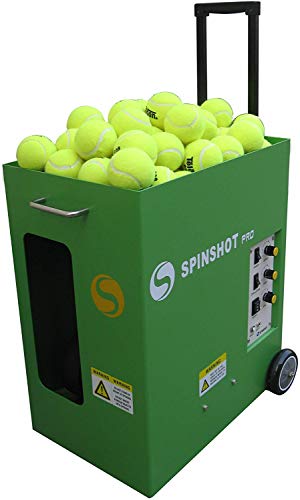
The Spinshot Pro is designed for ease of use and reliability, emphasizing a non-plastic construction for durability. It features knob-controlled settings for straightforward operation and supports flexible power options to fit different training setups. While marketed as simple to operate, it offers a robust feature set suitable for players who want consistent feeds and dependable performance without complexity. This model is positioned as a user-friendly option that enables consistent practice, from drills to drills, across various ball speeds and patterns.
PUSUN PT-MINIPro Portable Tennis Ball Machine

The PT-MINIPro from PUSUN is a compact, lightweight server designed for indoor use with 65+ ball capacity. It offers an 8-60 km/h ball speed range and a serving distance of up to 12 meters, with topspin and backspin options and vertical adjustment of 25–60 degrees. This model emphasizes portability and ease of use, making it a practical option for schools, clubs, or households seeking a budget-friendly yet capable training tool for group or individual practice.
Nisplay Portable Tennis Ball Machine

The Nisplay machine emphasizes portability with a 26-pound frame and oversized wheels, designed for easy transport and durability. It supports a maximum speed of 68 mph and offers manual oscillation and an elevation range up to 50 degrees, catering to a range of drills from flat drives to high lobs. External lithium battery support enables 4+ hours of operation, making it suitable for long practice sessions, car trips to the court, and training on varied surfaces beyond smooth indoor courts.
Furlihong 3807BH Tennis Ball Machine

The Furlihong 3807BH focuses on stability and adjustability, featuring a triangular iron base for solid support during operation. It offers adjustable speed settings and automatic left/right oscillation, along with an up-and-down launch port to vary the trajectory. This model is designed for versatile training across all levels, enabling players to simulate a wide range of shot trajectories and court positions while maintaining a stable platform for repeated drill sessions.
PUSUN Smart Tennis Ball Machine PT-Smart

The PT-Smart offered here emphasizes app control and 12 training modes with 100-ball capacity and 4–6 hour battery life. Its smart app enables remote speed, frequency, angle, and spin adjustments, with AI-assisted ball-paths that simulate realistic match dynamics. The device is suitable for players at all levels, including schools or clubs seeking a feature-rich trainer that can adapt to various drills and player progress.
App Control PT-Smart Pro Tennis Ball Machine

The PT-Smart Pro is an upgraded model featuring internal oscillation for unpredictable feeds and 20 programmable spots with 1.8–8s intervals, creating match-like rallies. It offers 75 mph serves and a 100-ball hopper, enabling long, continuous practice. Controls include speed, angle, topspin/backspin, and a suite of drills via app, remote, or Apple Watch. The Pro version targets intermediate to advanced players, coaches, and schools needing robust, realistic practice feeds.
Buying Guide: Key Purchase Considerations
Buying a tennis ball machine involves aligning features with training goals, budget, and usage context. Important considerations include ball speed range, spin options, and elevation control to recreate varied rally situations. Battery life and hopper capacity determine session length and reset frequency, while oscillation patterns—horizontal, random, or programmable spots—drive the realism of drills. Portability matters for home use vs. club or school settings, as do control methods such as app-based interfaces or remote controls. Durability, warranty, and service availability are essential for long-term reliability, especially in high-usage environments. For beginners, models with intuitive controls and preset drills accelerate learning; for coaches and advanced players, programmable drills and higher speeds support sophisticated training plans. Compare total cost of ownership, including battery replacement and spare parts, to ensure the best value over time.
Before purchasing, consider: expected training goals (technique, footwork, consistency), typical practice duration, number of users, court type, and whether you need portability or a stationary setup. If possible, test-feel features like feed consistency, ease of setup, and app responsiveness. A machine with a robust set of drills and reliable feed stability will consistently support progress, while a model with flexible speed and spin options better accommodates long-term skill development. Finally, evaluate after-sale support and availability of replacement batteries or parts to minimize downtime in busy training schedules.