
Best Carbon Fiber Insole Inserts for Turf Toe and Hallux Conditions
Answering the buyer’s search for durable, rigid insoles, these carbon fiber inserts provide stable support for turf toe, hallux rigidus, Morton’s toe, and related foot issues. They’re ideal for active individuals seeking a post-op shoe alternative or ongoing pain relief. The best options below are selected to fit a variety of shoes, activities, and recovery needs, with clear guidance on who benefits most from each insert.
| Product | Brand | Best For |
|---|---|---|
| EZWORK Carbon Fiber Insoles | EZWORK Store | Post-op shoe alternatives, wide shoe compatibility |
| TEGA Carbon Fiber Insole | TEGA Store | Turf Toe, Hallux conditions, athletic use |
| 1 Pair Carbon Fiber Insole – 0.8mm | – | Recovery walking, light daily wear |
| MARRDO Carbon Fiber Insole | MARRDO Store | Foot pain relief, everyday sports and daily wear |
| Morton’s Extension Orthotic | TEGA Store | Morton’s toe, turf toe, Hallux Limitus/Rigidus |
EZWORK Carbon Fiber Insoles

This pair is sold as one pair and fits both men and women. The insoles measure 1.2 mm thick and use a 180-degree flat plate to limit bending, providing stability and reduced pressure on the metatarsals. Best for those seeking a rigid support option that can function as a post-op shoe alternative. Not recommended for dress shoes or high heels. Suitable for Morton’s Toe, Turf Toe, Hallux Rigidus, and related foot pain conditions. Also marketed for athletic use, offering stability across walking, hiking, and sports activities.
Who it’s best for: active individuals needing strong forefoot stabilization and a post-op or recovery-friendly option. Why selected: thick, uniform rigidity, broad compatibility with several shoe types, and explicit use cases across common toe and joint conditions. Caution: not designed for dress footwear or fashion shoes.
TEGA Carbon Fiber Insole (1 Pair)
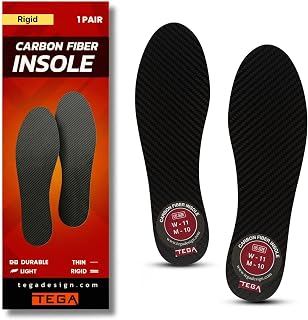
Sold as a pair, these 1.3 mm carbon fiber insoles minimize forefoot bending and add stability. They support recovery from Hallux Rigidus, Hallux Limitus, Turf Toe, fractures, and Morton’s Toe. They are not a soft foam insole and require proper sizing by removing the original insole and matching the length to the size chart. Best for athletes and active individuals who need rigid, supportive inserts to protect the forefoot during movement.
Who it’s best for: athletes and regular movers requiring substantial forefoot stabilization. Why selected: high rigidity, explicit medical-use cases, and clear sizing guidance. Caution: not a soft supportive insole; ensure correct size for your shoe.
0.8mm Carbon Fiber Insole – 1 Pair

This ultra-thin, 0.8 mm carbon fiber plate limits forefoot bending and reduces pressure on MTP joints. It’s designed for recovery walking and is particularly suitable when minimal bulk is desired under the forefoot. Best for individuals needing light to moderate stability with minimal footprint impact.
Who it’s best for: those recovering from forefoot injuries who want a discreet, low-profile insert. Why selected: thin profile, targeted support for big-toe and forefoot joints. Caution: very limited cushioning; may be less forgiving on high-impact activities.
MARRDO Carbon Fiber Insole

Sold as a pair, these carbon fiber insoles provide support, stability, and shock absorption. They aim to relieve foot pain by keeping pressure off the metatarsal joints and toes, with broad use for Hallux Limitus, Morton’s Toe, Turf Toe, Hallux Rigidus, and related conditions. Suitable for daily wear and many sports, including running and hiking. Noted for a strong, rigid core within a full-length insole.
Who it’s best for: people seeking robust, all-day support with broad sports compatibility. Why selected: comprehensive feature set and dual-foot pairing. Caution: check your doctor’s advice to confirm fit for your specific condition.
Morton’s Extension Orthotic

Morton’s Extension orthotics are sold as a pair, with one for each foot. They’re designed to limit motion of the big toe joint, reducing pain from Turf Toe, Hallux Limitus, and Turf Toe-related conditions. The size guidance recommends measuring the current insole length to select the correct carbon fiber insole size. Best for those needing targeted big toe joint stabilization in daily wear and sports.
Who it’s best for: individuals with Morton’s toe or big toe joint instability. Why selected: purpose-built for toe joint stabilization; paired sizing supports both feet. Caution: verify the right size to ensure proper fit across activities.
Buying Guide
- What condition are you treating? Choose stiffer, full-length carbon fiber plates for stable load distribution and post-op alternatives; use thinner options for discreet wear or light recovery.
- Should you buy in pairs or single? For both feet or bilateral conditions, buy pairs; many products are sold as pairs to ensure balanced support.
- How thick should the insert be? Thicker plates (around 1.2–1.3 mm) provide more rigidity and toe protection; thinner plates (0.8 mm) offer low-profile stabilization with less bulk.
- How to size correctly? Remove your current insole, measure its length, and match to the manufacturer’s size chart. Correct sizing prevents pressure points and maximizes relief.
- Can these be worn with athletic shoes? Yes, most are compatible with sneakers, hiking boots, and sport-specific footwear. Avoid dress shoes or high heels for rigid insoles.
- What are the limits? Rigid carbon fiber inserts are not soft insoles. They may feel unusual at first and can require a break-in period and proper shoe fit.
Frequently Asked Questions
- Are carbon fiber insoles reusable? Yes. They are designed for repeated use and can be transferred between compatible shoes, provided the fit remains correct.
- Can these replace a post-op shoe? Some inserts are marketed as alternatives to post-op footwear, but always follow medical guidance for post-operative recovery.
- Do I need a doctor’s clearance? For persistent toe joint pain or after injury, consult a clinician to ensure these inserts suit your condition.
- Will carbon fiber insoles fix bunions? They primarily stabilize the forefoot and joints; bunion relief varies and should be part of a broader treatment plan.
- Can I wear them for running? Many inserts are designed for daily wear and light activities; choose a product explicitly marketed for athletic use if running is primary.
- How long do they last? Durability depends on usage and shoe compatibility; inspect for cracks or deformations and replace as needed.