
Best Slide Boards for Knee Rehab: Best Tools for Accessible Recovery
Answering the question of what slide board can support knee rehabilitation, these five options are designed to help users regain range of motion with controlled, low-impact movements. They’re best for individuals recovering from knee replacement, ACL/PCL procedures, hip surgeries, or other lower-body injuries who want consistent, clinician-style ROM practice at home or in a clinic. The list prioritizes boards that offer smooth gliding, clear sizing, and practical portability.
Summary table of selected products:
| Product | Best For | Material / Design | Notes |
|---|---|---|---|
| Heel Slide Board | Post-op knee flexion, bed-based rehab | Tempered hardboard, low-friction top | Full 28″ length; lightweight |
| Knee & Hip Rehab Glider | Home or clinic rehab, stroke recovery | Oak wood | Lightweight, portable |
| OPTP Knee Glide by Bob and Brad | Seated knee and lower-body therapy | Synthetic material (glider design) | Multi-use for knees and shoulders |
| JFMkaer Knee Replacement Recovery Aids | Gradual ROM progression | Flexible fabric/board aids with bands | Three resistance levels |
| JFMkaer Knee Replacement Recovery Aids (2) | Versatile post-op rehab | Glider with dual functionality | Therapist-recommended |
Heel Slide Board — Full Knee Flexion, Bed Rehab

This board is engineered specifically for heel slides, offering a frictionless glide and a non-slip backing to keep it stable on beds, couches, or floors. The 3/16″ tempered hardboard keeps the board thin and light for easy handling during recovery. Best for patients who need a reliable, long sliding distance from straight leg to deep knee bend.
- Best for bed-based knee flexion exercises and post-op ROM rehab.
- Limitations: Do not stand or step on the board; designed for sliding motions only.
- Size matches standard clinic dimensions for comfortable full-range movement.
Who it’s best for: Individuals focused on maximizing knee flexion while lying or seated, particularly after knee replacement or ACL rehab where range-of-motion progression matters.
Knee & Hip Rehab Glider — Lightweight Oak
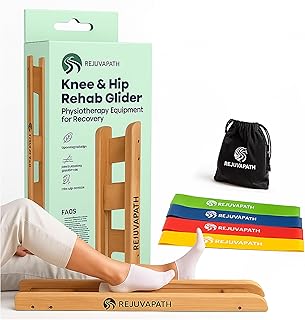
This glider emphasizes smooth gliding motion to improve knee and hip mobility, making it suitable for post-surgery recovery, stroke rehab, and general physical therapy. Crafted from premium oak, it balances durability with portability, enabling easy use at home or in clinics.
- Best for controlled, low-impact movement that supports blood circulation and joint flexibility.
- Limitation: May be heavier than all-plastic counterparts; best used on flat surfaces.
- Ideal for ongoing mobility work and multi-joint rehab routines.
Who it’s best for: Patients who want a sturdy, aesthetically appealing option that’s easy to transport and store between sessions.
OPTP Knee Glide by Bob and Brad

Designed for knee and shoulder rehab, this glide device supports low-impact, seated exercises ideal for early ROM work and long-term rehab. It is marketed for a wide range of recovery scenarios, including ACL, PCL, hip replacement, and rotator cuff therapy, making it a versatile choice for rehab plans that involve both legs and upper body.
- Best for seated knee therapy and multi-region rehab with minimal strain.
- Limitation: Primarily a gliding aid; users should follow therapist guidance for progression.
- Easy use at home or in clinical settings with straightforward instructions.
Who it’s best for: People seeking a compact, adaptable device that supports knee rehab within a broader physical therapy program.
JFMkaer Knee Replacement Recovery Aids — Gradual Mobility

This recovery aid supports gradual activity after knee replacement, helping users gently bend the knee with controlled resistance. It includes three resistance levels to tailor progression as strength and flexibility improve. The device is designed to reduce knee stress while encouraging ROM growth.
- Best for gradually increasing range of motion and reducing stiffness post-surgery.
- Limitation: Requires careful progression to avoid overexertion; best used under guidance.
- Three-band resistance lets users adjust intensity through recovery stages.
Who it’s best for: Patients prioritizing a structured, progressive ROM routine with built-in resistance options.
JFMkaer Knee Replacement Recovery Aids — Dual-Function Glider

This multifunctional knee glider offers both lying-down and seated exercise options, enabling rehab across different recovery stages. Therapists commonly endorse such devices for stability and muscle training during post-operative recovery, aiding flexibility and strength while reducing joint strain.
- Best for versatile rehab routines that adapt to comfort and progress.
- Limitation: Effectiveness relies on proper guidance to determine suitable positions and repetitions.
- Therapist-recommended for use as part of a structured rehabilitation plan.
Who it’s best for: Individuals who want a flexible device that supports both supine and seated exercises during knee rehabilitation.
Buying Guide: Key Considerations For Choosing A Knee Rehab Slide Board
What matters most when selecting a slide board for knee rehab? Consider the following factors to align products with your recovery plan and living situation.
- Purpose and motion: Do you need a board for bed-based heel slides, or a glider for seated or standing routines? Choose a design that supports your target movement patterns.
- Material and durability: Hardboard, wood, and composite gliders offer different levels of stability and portability. Lighter boards are easier to handle but may be less rugged over time.
- Size and fit: Measure from hip to ankle to ensure the board length accommodates your range of motion. Longer boards typically enable deeper knee bends.
- Stability and safety: Non-slip backs, friction reduction, and secure placement help prevent slips during repetitions. Ensure the board is appropriate for the surfaces you use at home.
- Portability: If you travel between home and clinic, a lightweight option with simple setup is advantageous.
- Guidance and progression: Some products come with suggested exercise guidance or endorsements from therapists; follow a clinician’s plan to progress safely.
- Budget and space: Consider how much room is available for storage and whether a single device supports multiple rehab goals.
FAQ: Knee Rehab Slide Boards
- What is a knee rehab slide board best used for?
They are best for controlled, low-impact movements to regain knee range of motion after surgery or injury, often focusing on heel slides, flexion, and leg mobility.
- Can I use these boards at home?
Yes. Most slide boards are designed for home or clinic use, with varying levels of portability and ease of setup.
- Is a longer board always better?
A longer board can enable deeper knee bending, but it must fit your space and your body’s leg length. Longer boards are not necessary for everyone.
- Should I involve a physical therapist when using a slide board?
Consult a therapist to tailor progression, especially after surgery. Some devices are designed with therapist guidance in mind.
- Are wooden boards safer than plastic ones?
Both can be safe if used correctly. Wooden boards are typically sturdy and durable, while plastic or composite boards may offer lighter weight and smoother gliding.
- Can I use a slide board for hip rehab as well?
Yes. Some boards support hip mobility and knee movement in combination with leg exercises; check product features for suitability.